
The Salmon & Trout Conservation (S&TC) has published “Doing its job?”, a report on the state of the Environment Agency and its role in protecting English rivers, lakes and streams.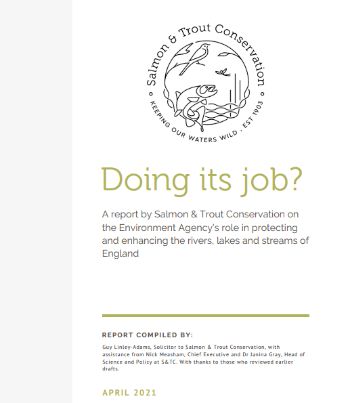
The Salmon & Trout Conservation (S&TC) has published “Doing its job?”, a report on the state of the Environment Agency and its role in protecting English rivers, lakes and streams.
The report concludes that the Agency is failing to protect rivers, not monitoring, inspecting or prosecuting enough, with its hands tied by central Government.
The conservation group is calling on the Government to sufficiently fund the EA, and ensure it is appropriately staffed, to undertake the work required to restore the freshwater environment to good ecological status.
Nick Measham, Chief Executive of S&TC said:
“The Environment Agency turned 25 years old this month but our rivers will not be celebrating. Despite a quarter of a century of its oversight, the freshwater aquatic environment is still heavily polluted, fragmented and we face a biodiversity crisis with many freshwater species in steep decline or, in the case of the Atlantic salmon, at risk of extinction. We are at a point when business as usual is no longer an option if we are to reverse wilful river damage and habitat destruction”.
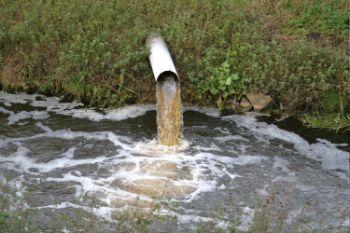
The report says that the basis of any strategy to protect and enhance the freshwater environment has to be monitoring, but the EA’s monitoring efforts have shrunk considerably over time. There is no longer a coherent and comprehensive picture of the state of the freshwater environment in England, with old data used to plug today’s data gaps.
The Report shows that:
- over the last decade or more, what little progress there had been in improving the overall quality and ecological status of the freshwater environment in England has plateaued. Only 14% of English water bodies are in good ecological condition.
- stock surveys show 59% of those water bodies are not achieving good or better status for fish.
- 39 out of our 42 main salmon rivers are ‘at risk’ or ‘probably at risk’.
- despite a legal requirement on the Agency to establish and maintain a coherent and comprehensive monitoring programme to assess water status across England, we have a very limited picture overall of the actual situation in the freshwater environment.
- monitoring by the Agency has reduced dramatically over recent years and looks set to reduce further both in terms of monitoring the wider environment and also monitoring of polluting discharges to and abstraction from rivers.
The Report also shows that:
- the introduction of operator self-monitoring by the Agency ten years ago, whereby dischargers were left to monitor themselves, dramatically reduced the deterrent to would-be polluters and, as the evidence shows, has opened the door to cheating;
- the rate of inspection carried out by Agency staff at regulated sites has reached an extremely low level with some water company sewage treatment works not being inspected over an entire decade. Many will only receive a single visit from the EA over five or more years.
- the EA inspection rate of English farms, now subject to regulations on avoiding agricultural diffuse pollution, means that farms can only expect to be inspected once every 263 years.
- the number of prosecutions conducted by the EA has dwindled dramatically over time with the rate of decline increasing rapidly since 2012/2013.
- the useful stigma of criminal conviction has largely been removed as a deterrent to would-be polluters and those who would harm the freshwater environment.
- the EA’s overall environment and business budget has shrunk dramatically over the last decade and was, in 2017, roughly only 60% of its 2008 level.
The report is also calling for operator self-monitoring to be abolished, with the EA either returning to a system of taking samples itself by way of its own staff visiting points of discharge, or by way of the installation of continuous monitoring equipment operated not by dischargers or abstractors, but by the EA itself or contractors to the EA.
“Government has starved the Agency of funds …dwindling staff confined to barracks and shackled to their desks”
Guy Linley-Adams, Solicitor to S&TC and author of the report said:
“The system is broken. Over recent years, our environmental regulator has been made subject to all manner of deregulatory initiatives and business-friendly codes, all designed to place economic growth above the environment. To make matters worse, Government has starved the Agency of funds, with its dwindling staff confined to barracks and shackled to their desks.
"The watchdog has been beaten, chained up and muzzled”.
According to the report, the EA admits it is “over-reliant on water companies reporting their own pollution and breaches, but defends the practice.”
The Report makes a number of recommendations including that the Government should urgently amend the legal rules and codes under which the Agency operates in order to allow it the freedom to pursue its statutory objective to protect and enhance the environment in a way that is unencumbered by deregulatory, overly business-friendly, or pure economic growth agendas.
It also highlights that it would be incorrect to blame the EA’s front-line staff for the reduced inspection, reduced attendance at pollution events, reduced monitoring of both receiving waters and of discharges, and reliance on self-monitoring and self-reporting by would-be polluters and softer enforcement with fewer prosecutions. “In most cases, their hands are tied,” the report says.
Nick Measham added:
“I would ask both the EA and DEFRA to think hard before they respond to the report with spin that that the EA is performing wonderfully. Those of us on the riverbank - and many of the Environment Agency’s own committed staff - know that the Agency is not delivering the protection and enhancement our freshwater habitats so desperately need, the public demands and that the law required of the Agency back in 1995.”
Click here to download the report Doing its job in full

Sign In
